
Outsourcing software development to India: a guide for Australian businesses
Outsourcing software development to India lets Australian businesses build more for their budget, with a working day that overlaps comfortably with Australian hours. It works well when there's a clear scope, a single accountable contact, regular working demos and agreed privacy and ownership terms. It goes wrong when those are missing, so the partner's process matters more than the country.
Why do Australian businesses outsource software development to India?
- Budget: development rates in India are considerably lower than local Australian rates, so the same budget builds more.
- Time zones: India is 4.5 hours behind AEST and 5.5 hours behind AEDT, so there's a shared working window every day for calls and reviews.
- Talent: a large pool of experienced developers across modern stacks such as React, Next.js, Node.js and mobile.
- English: business communication in English is standard.
- Flexibility: scale a team up or down by project instead of hiring permanently.
What are the risks, and how do you avoid them?
| Risk | How to avoid it |
|---|---|
| Unclear scope, so the result isn't what you expected | Agree a written scope with screens and acceptance criteria before work starts. |
| Going quiet for weeks, then a big surprise | Insist on working demos every one to two weeks, not just status updates. |
| Hidden costs from change requests | Fixed price per phase, with any change quoted before it's built. |
| Code or accounts held by the vendor | Your own repository, hosting and domain from day one; you own the IP. |
| Privacy and data handling | Agree how personal data is handled, who can access it and where it's hosted, in line with the Australian Privacy Act. |
| Quality issues found too late | Testing in every round, plus a staging site you can try yourself. |
Which engagement model should you choose?
| Model | How it works | Best for |
|---|---|---|
| Fixed-scope project | A defined result for an agreed price and timeline, delivered in phases. | Websites, CRMs, portals and apps with a clear goal |
| Dedicated team | Developers working on your product ongoing, managed by you or the partner. | Products with a continuous roadmap |
| Hybrid | A local owner or product lead in Australia, with the build team in India. | Businesses that want local accountability and offshore speed |
Most small and medium businesses do best with fixed-scope phases: you know the cost of each step and can stop, pause or change direction between phases.
How to choose a software development partner in India
- Ask for case studies with live links, ideally for Australian clients and businesses like yours.
- Check who you'll actually talk to, and whether they understand your business, not just the code.
- Ask how they handle changes, testing and handover, and get it in writing.
- Confirm that you'll own the code, accounts and data from day one.
- Start with a small, well-defined first phase before committing to a big build.
How Flomoat works with Australian clients
We're based in Chandigarh and many of our clients are Australian businesses, including a home-modification company, a nail salon, a mortgage broker and an accounting practice. We work in phases with a written scope, share working demos regularly, keep everything in accounts you own and schedule calls in the overlap with Australian business hours.
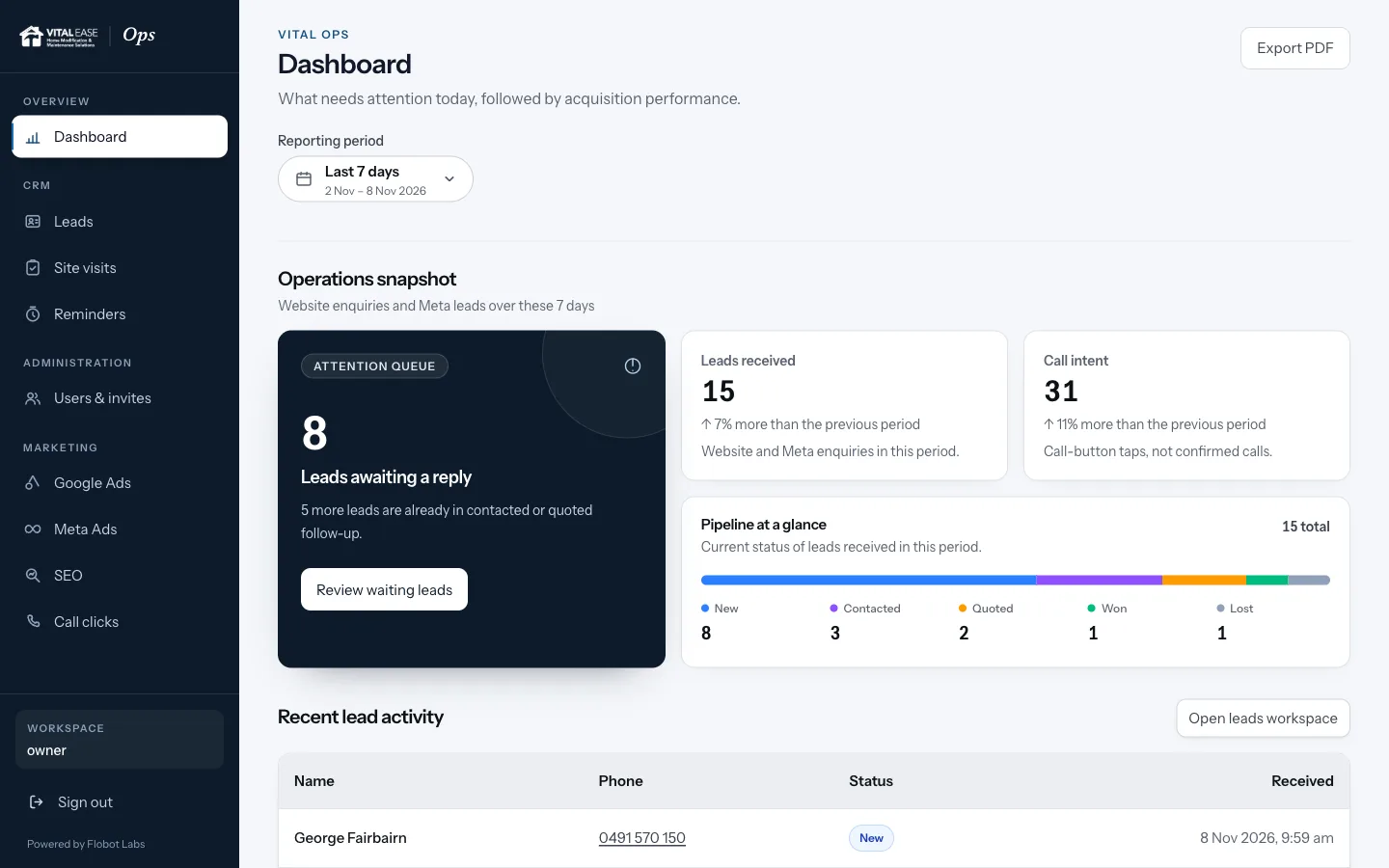
Vital Ease, a Melbourne home-modification company, works with us from India on their website, their Vital Ops CRM and site-visit tool, and their Google Ads, Meta Ads and SEO, built and shipped in phases.
Read the case studyCommon questions
What is the time difference between India and Australia?
India is 4.5 hours behind Australian Eastern Standard Time and 5.5 hours behind during daylight saving, so there's a shared working window each day for meetings and reviews.
Will I own the code if I outsource development?
You should. Agree upfront that the code, accounts, domain and data belong to you, and that work is stored in a repository you control. We work this way by default.
Is outsourcing compatible with the Australian Privacy Act?
It can be, when it's planned for. Agree how personal information is handled and accessed, where it's hosted and how it's protected before any personal data is shared.
Is it better to hire a freelancer or an agency?
A freelancer can suit a small, well-defined task. For a business system that needs design, development, testing and ongoing support, a small team gives you continuity and isn't dependent on one person.